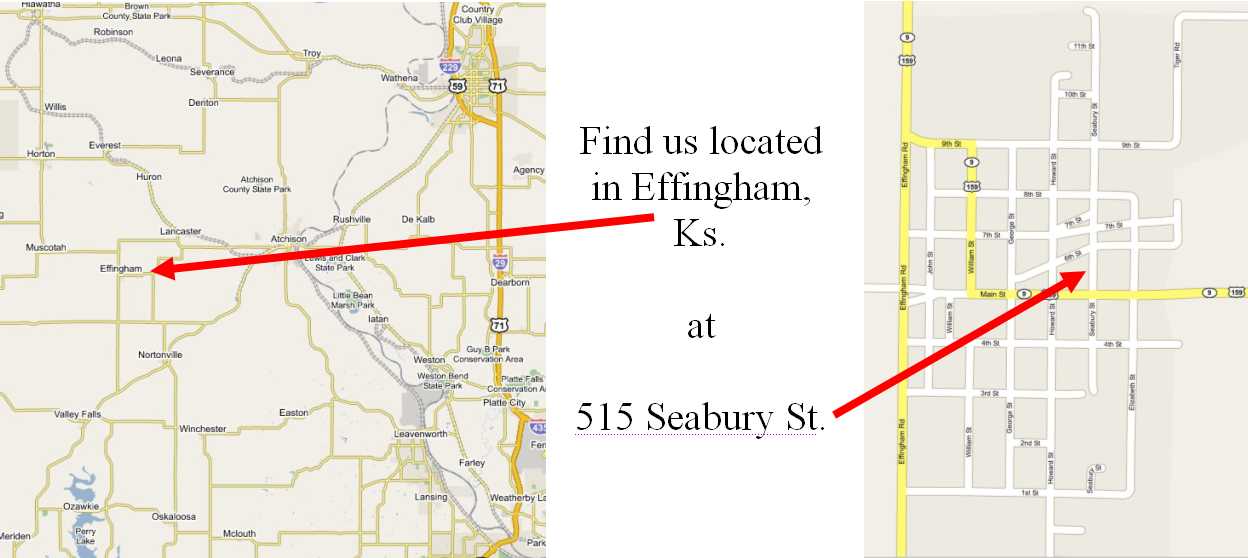
|
The History of Methodism In Effingham,
Kansas
|

The history of
Methodism in Effingham, Kansas has many strands that weave
together making it what it is today. The only church record
books that were available for this history were the records from
1894-1914 and 1919-1928. The rest are missing at this point.
This history has relied upon several secondary sources to piece
the story together.
Early records
indicate that the Methodist Episcopal Church work in Kansas was
officially begun in 1854 when the Missouri Conference met and
formed the Kansas and Nebraska Mission District. There were
seven missions, not including the work among the Indians. Rev.
Goode was appointed as the presiding elder over this area. A
year later it was reported that there were 631 white members,
and 127 Indian members of The Methodist Episcopal Church located
in Cygnes, Fort Scott, Fort Riley, Nemaha, Wolf River,
Wyandotte, and Delaware. Kansas was divided into two districts,
with L.B. Dennis appointed to supervise the North Kansas
District, based out of Leavenworth, and Abraham Still appointed
to the South Kansas District, based out of Topeka. Anticipating
additional migration of whites into the area, the two Kansas
districts along with the Nebraska District were organized into
the Kansas-Nebraska Conference. The organizational meeting took
place at Leavenworth, Kansas on October 23, 1856. In 1861 the
conference divided again and the Kansas and Nebraska Conferences
were formed. By 1870 the Kansas Conference was reporting 103
preachers, 233 local preachers, with 10,290 members.[1]
The Methodist
Episcopal Church came to Atchison county when Rev. James Shaw, a
prominent member of the Detroit Conference, came west looking
for a new place to live. He had served as a pastor and a
missionary among the Native Americans in the Lake Superior
District. He arrived in Leavenworth in March of 1856. Upon
finding a Methodist Episcopal Church work already in existence,
he moved further north to Atchison.[2]
Atchison had been the scene of an ongoing conflict between the
abolitionists and the pro-slavery elements that were vying for
dominance in the pre-statehood days of Kansas. By 1856,
Atchison was noted as being predominantly a pro-slavery
community.[3]
Upon finding Atchison to be unfriendly toward preachers, Rev.
Shaw went further north to Doniphan and Geary, both of which
were free-state towns. The people of Geary welcomed him and
invited him to make his new home among them. He returned to
Detroit and brought his family to their new home in Geary.
Shortly after he began his ministry there, he was visited by a
gentleman whom he refers to as ‘Brother Butts’ who invited him
to serve as the pastor of the Atchison-Monrovia Circuit.[4]
He agreed and was officially appointed as the pastor, beginning
his ministry there in May of 1857.[5]
Monrovia was located along the Central Branch Railroad[6]
about fifteen miles west of Atchison. Services were held every
other week during the summer, weather permitting, in the home of
J.H. Snyder, an Evangelical Lutheran,[7]
who migrated from Tuscarawas County, Ohio.[8]
The Monrovia Circuit was organized in 1859 and included all the
territory between Monrovia and Sumner. The first pastor for
this new circuit was Rev. A.C. McNeal.[9]
According to the records
left by Aaron Best, an immigrant from Pennsylvania, there was
still no church building in Monrovia when he arrived there in
1861.[10]
Aaron joined the Methodist Episcopal Church, which he noted was
organized in 1860. He went on to serve as steward and class
leader for several years.[11]
In 1882 a Methodist
Episcopal Church was organized in Effingham, Kansas, about three
miles further west of Monrovia along the railroad. Effingham
was named after Effingham H. Nickels of Boston, who was a
promoter of the railroad.[12]
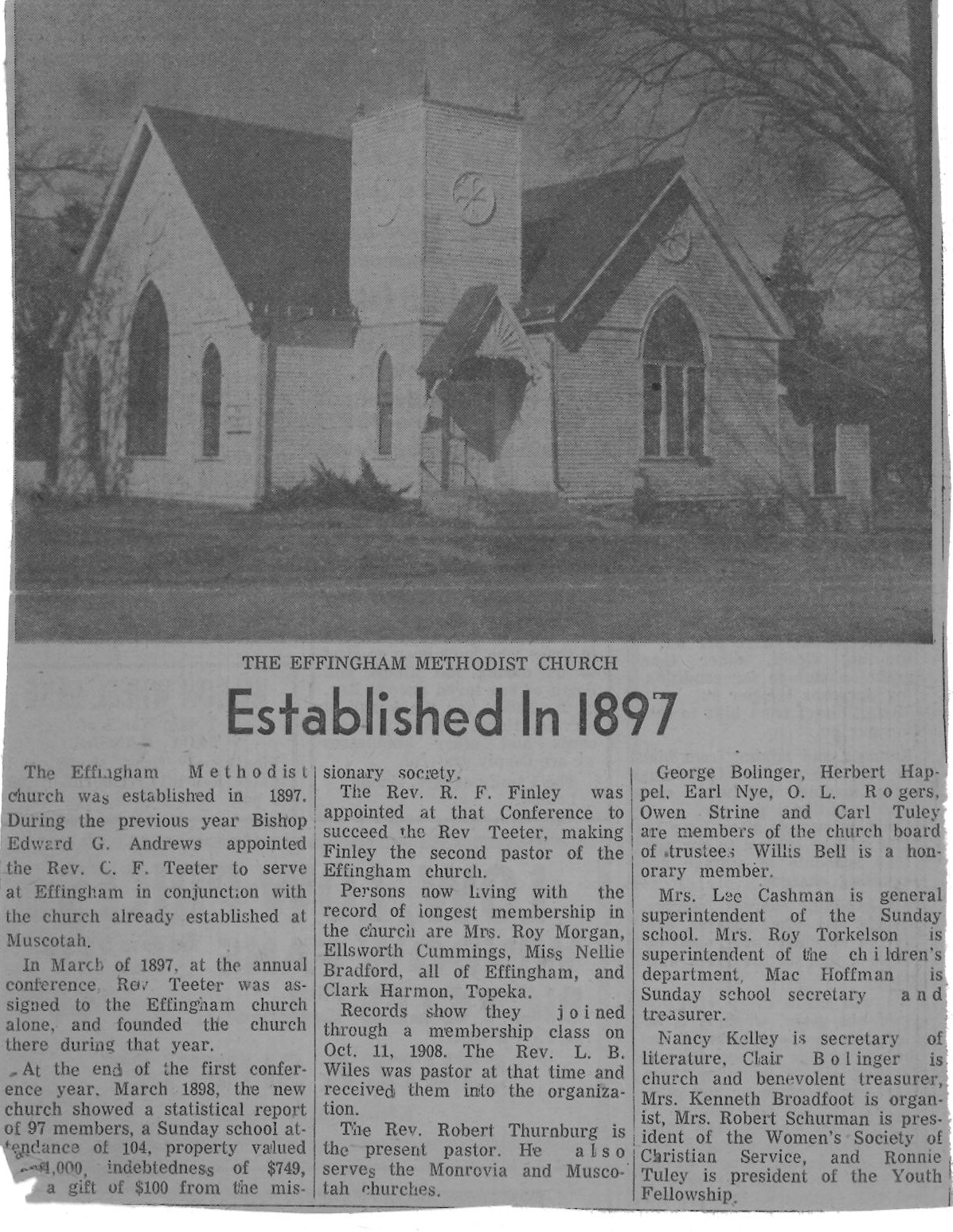
The church met in the school house until a building was built in
1894 on the northeast corner of Third and George Streets[13].
This building was used until the 1970’s. Early records of the
local church do not give us information regarding who the
pastors were from 1882-1896, but other sources indicate that J.S.
Smith of Muscotah was the pastor in 1883.[14]
Based upon this information, J.S. Smith could have been the
pastor who helped organize the church in 1882.
The next branch of
Methodism to consider is the Methodist Episcopal Church South.
The roots of this part of Methodism go back to 1850 when the St.
Louis Conference had circuit riders that crossed the borders
into Kansas and Nebraska and began preaching wherever they found
people. In 1854 the St. Louis Conference formed the Kansas
Mission District with Andrew Monroe as Superintendent. The
newly formed district consisted of eight preaching circuits in
addition to its Indian mission work. In 1855 the Methodist
Episcopal Church South reported 619 members compared to the
Methodist Episcopal Church reports of 631. The Kansas Mission
District was also organized into two districts that same year;
the Lecompton District with William Bradford as presiding elder,
and the Kickapoo District with Nathan Scarritt. With the
outbreak of the Civil war, the last recorded Methodist Episcopal
Church South Conference was held in the fall of 1861 on a farm
located on Grasshopper Creek several miles west of Atchison.
There are no records of this final session but pastors were
assigned to their posts and the ministry struggled to continue
in Kansas, which was now a free state. Some of its circuits
became attached to the St. Louis Conference and others became a
part of the Missouri Conference. Many of the preaching points
simply disappeared. In 1866 the Missouri Conference once again
tried to establish the Kansas work by forming the Leavenworth
District. This district did not survive its first year but some
of the work continued from the St. Joseph District and others
continued from the Nebraska circuit in the Savannah District.[15]
The Methodist
Episcopal Church South organized in 1878 in Effingham. Rev. J.W.
Thorpe was the presiding elder of the Troy Circuit in 1871 and
included the Effingham community in his itinerary. The first
appointed pastor was Rev. C.A. Sherman. A building was built in
1881[16]
on George Street, north of the railroad, on the west side of the
street, between Main and Seventh Streets.[17]
There were 22 members in 1883.[18]
George Kurn was the pastor around 1888.
[19]
Some of Kurn’s granddaughters, Elsie Hawk and Mary Sharp, still
live in Effingham. The Methodist Episcopal Church South
congregation merged with the Methodist Episcopal Church in
Effingham in the early 1900’s.[20]
Their building was used as a school for black children[21]
until it was purchased in 1907 by the St. Ann’s Catholic Church
in Effingham. The Catholics moved the former Methodist
Episcopal Church South building to a location near their church
and continued to use it for a parochial school.[22]
The next change for
the Effingham Methodist Episcopal Church came in 1939. The
Methodist Protestant Church, The Methodist Episcopal Church
South and the Methodist Episcopal Church merged to form The
Methodist Church. This change had no significant impact upon
the local church, other than to change its name.[23]
In 1962, another
merger occurred that did affect The Methodist Church in
Effingham. The Monrovia Methodist Church was closed and all the
members became affiliated with The Effingham Methodist Church.
The Monrovia building was subsequently sold to Pat and Esther
(Olson) Chisom of Kansas City. (Esther was a former resident of
Monrovia). The church building in Effingham was remodeled with
new paneling in the interior, and the exterior was repainted.
Indoor plumbing was also added to the church in 1966.[24]
Perry Garten was the chairman of the board, Kenneth Broadfoot
was the lay leader and Sunday School superintendent, Al Heusi
was chairman of the trustees, and Mrs. Glenn Nichols was the
president of the Women’s Society of Christian Service.[25]
The last major strand
of the church in Effingham began with the fall meeting of the
Highland Presbytery in 1872. Rev. J.T. Whitemore was appointed
to visit Effingham to preach and discern interest in starting a
Presbyterian Church in that area. He came in November of that
year and preached in the school house on the northwest corner of
the Keplinger farm, one half mile east of town. After the
service the following people expressed interest in forming a
church organization: Peter Carmichael, Edward T. Ayer, Ruben
and Lucy Ferguson, Alexander and Flora Cameron, Maggie and
Isabell Fraser, Jane Stewart, Nancy Speedy and Sara McGillivray.
Peter Carmichael and Ruben Ferguson were elected as elders, and
Edward T. Ayer and Alexander Cameron were elected as deacons.
The young church had
to depend upon visiting and transient ministers for their
preaching until January, 1874 when the church was incorporated.
Rev. S.N. St. John was secured to serve as stated supply. At
this time the following names were added to the church roll:
Mrs. Lizzie Anderson, Mrs. Sarah Hawk, Miss Sadilla E. Hawk,
Miss Eda V. Hawk, Francis Loomis, Alex Walker, Mr. And Mrs.
Thomas Temple, and Mrs. Frances Van Wagoner. About this time
the meetings were changed from the school house to the Central
Branch depot.
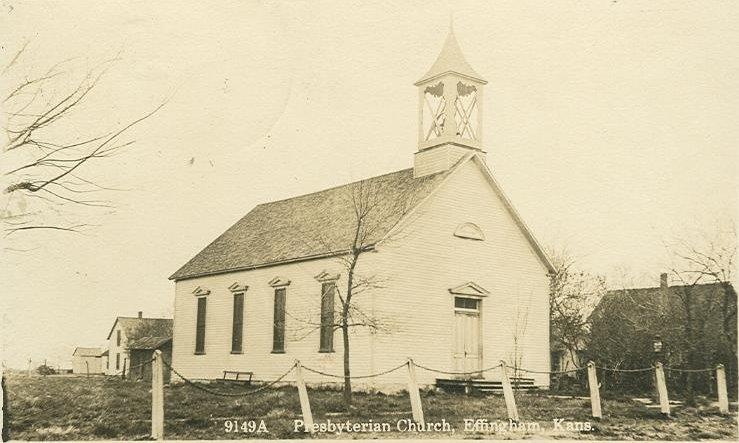
Plans to build a
church began in 1874, with three of the members conducting a
pledge drive. Shortly after the pledge drive began, a plague of
grasshoppers devastated the area. Plans to build were dropped
until 1876.[26]
The building was a 24’x36’ one room structure, located on the
northeast corner of Main and Seabury.[27]
It was finally completed and dedicated in December of 1877.
Rev. Dr. S. Hill from Kansas City assisted Rev. St. John in the
dedicatory services.
[28]
This building was later sold to the Baptists and a larger
building was built in 1881 between Fourth Street and Main Street
on the west side of William Street.[29]
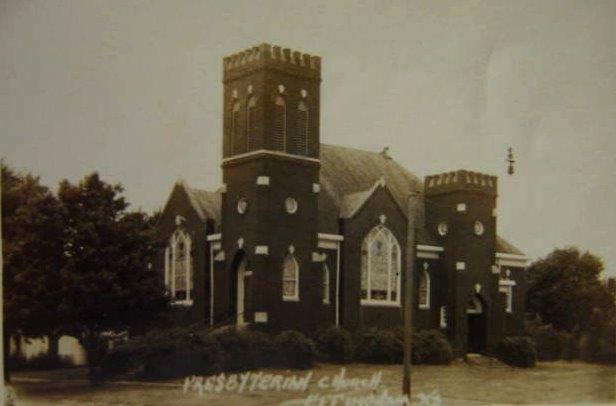
(The Fair Barn is located there presently.) In 1911 the
congregation once again decided it was time to build a larger
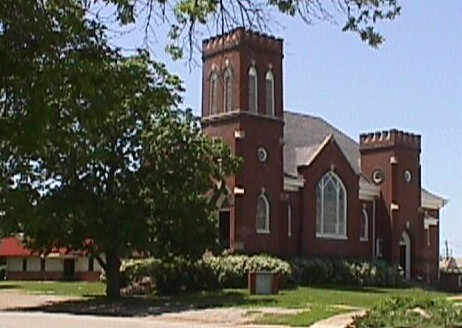
building. This building was a spacious brick structure located
on the southwest corner of Sixth and Seabury Streets. The
cornerstone was laid on September 12, 1912, and the building was
officially dedicated on June 19, 1913.[30]
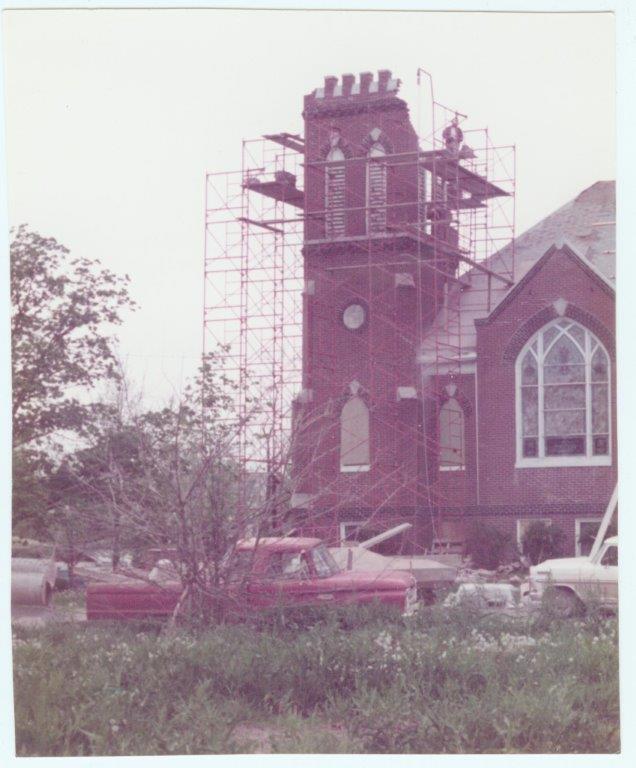
In the mid 1960’s the building was sand blasted and a new roof
was put on. The members repaired plaster and redecorated the
interior.
Moving back to the
Methodist side of the history, The Methodist Church began
operating a food stand at the Atchison County Fair in Effingham
during the 1950’s. Initially, the proceeds for the food stand
were used for building improvements. One of the first projects
of the Homebuilder’s Class was to dig a basement under the
church building. The food stand also became a source for
raising funds for mission projects as well as supplementing the
church budget. The Homebuilders’ Class built a building to
house the food stand in 1964.[31]
This building was destroyed in a tornado on April 26, 1984.[32]
It was rebuilt and ready for use by fair time in August.[33]
Damages to the community of Effingham were between 2-2 1/2
million dollars,[34]
and damages overall from the tornado were estimated at closer to
five million dollars.[35]
With the end of the
1960’s, change was once again coming to Effingham. First, there
was a merger involving the joining of The Evangelical United
Brethren and The Methodist Church denominations to form The
United Methodist Church in 1968. Subsequent to that merger, The
United Methodist Church in Effingham came to a crisis in the
winter of 1970-71. They were facing some major concerns that
would force changes in their local operation. Pledge cards were
mailed to the members and friends of the church for the annual
pledge drive. Of the 65 cards that were mailed, only 25
responded with pledges totaling $3500. At that time The United
Methodist Churches in Effingham and Muscotah were on a circuit
together. The Muscotah congregation was proceeding with plans
to form a union with the Muscotah Congregational Church. If
that merger took place, the Effingham United Methodist Church
was going to be responsible for all of the support of the
pastor. About this same time, The Presbyterian Church of
Effingham was experiencing a similar problem. They had been on
a circuit with The Presbyterian Church in Horton. The Horton
congregation had disbanded in 1970 and their pastor was planning
to retire at the end of May, 1971. Leaders from these two
congregations began exploring the possibility of creating a
union church which would enable the United Methodists and
Presbyterians to continue to keep an effective Christian witness
in Effingham. In March, 1971, after weeks of ongoing discussion
with the officials of both denominations and each other, the two
church boards recommended to their congregations that they
proceed with a unified ministry. The merger committee,
designated as ‘The Appointed Committee’, was made up of Robert
Caplinger, chr., (non voting member), A.C. Asher, David
Bodenhausen, Gene Cashman, Duane Hawk, Alfred Heusi, Venita Jo
Rader, Owen K. Strine, and Clarence Todd.[36]
The proposed union was to be done on a trial basis for a one
year period. Toward the end of that time it would be evaluated
to discern if that was the direction that the congregations
wanted to continue.
The following April,
a poll was conducted[37]
and both churches agreed to continue the joint ministry with
plans to draft by-laws governing the structure, subject to the
approval of both denominations. The By-Laws were prepared by
Robert D. Caplinger, and the necessary approval was obtained.
The first Annual Meeting of the Effingham Union Church was on
December 3, 1972.[38]
Highlights of the By-Laws provided for the members to continue
on in their denominational affiliation if desired, or simply
being listed as ‘Union Church Members’, with 1/2 of the members,
attendance, and finances being reported to each denomination for
statistical reports.[39]
The church pays 1/2 of each denomination’s apportionments
request.[40]
The church alternates pastors between the Presbyterian and
United Methodist clergy.[41]
The Nominating Committee consisted of the preexisting nominating
committees of the previous churches to insure fairness in
representation.[42]
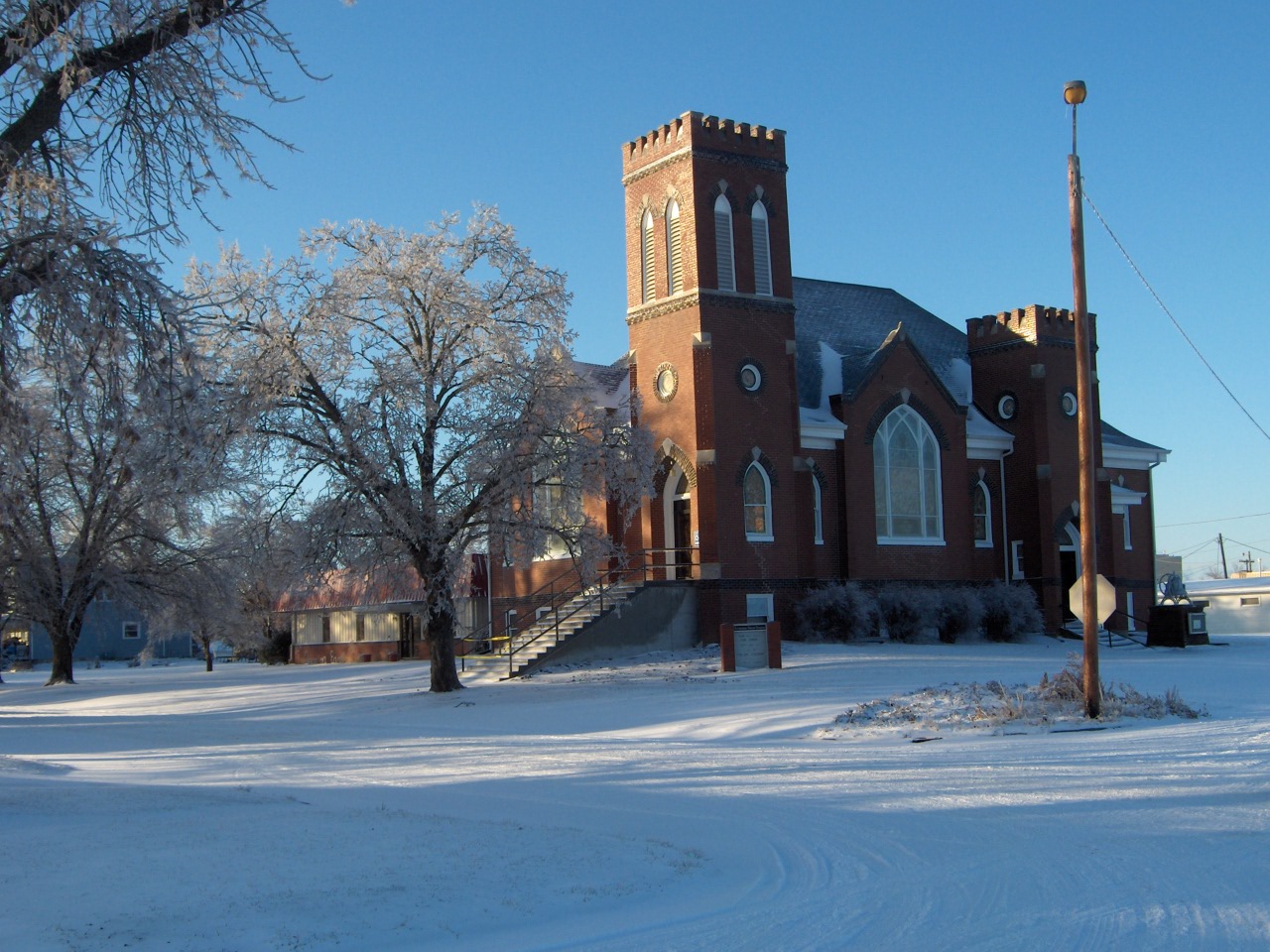
Subsequent to the
merger, additional improvements were made in the former
Presbyterian building. Being a sturdy brick structure, it
seemed natural that this building would eventually become the
main building. In 1976, the difficult decision was made to
discontinue the use of the United Methodist building.
Maintaining and using both buildings on opposite sides of town
for various activities was becoming impractical. The United
Methodist building was sold to Walter F. Sutter with the
stipulation that it was to be torn down.[43]
Following the demolition of the Methodist building, plans were
laid to build an educational building adjacent to the Union
Church facility. Proceeds from the sale of the United Methodist
Church building and parsonage had resulted in a $15,000 building
fund to start the project.[44]
A ground breaking ceremony was held for the Christian Education
Building on October 30th, 1977, and the building was complete by
September of 1979. A dedication and mortgage burning
celebration was held on October 4, 1980. The generous gifts of
God’s people made a dream become a reality.[45]
Not only did the people give, but once again the Food Stand at
the Atchison County Fair provided some much needed income to
help with a major building project.
The most recent
project the church has undertaken was the building of a new
parsonage in the summer of 1993.[46]
The old, white-painted frame, two-story building that frequently
needed maintenance was replaced with a modern one-story home
with a two car garage.
Today, the Effingham
Union Church is still an active Christian witness in the
community and surrounding area. In the summer of 1998, the
church had been without a resident pastor for seven months.
Many churches experience an attendance slump during the summer,
but not Effingham. They were making it a goal to have a high
attendance of 90 for Sunday School. They finally made it in
August, a couple of weeks before school started. Summer Sunday
School is a plus that the children look forward to each
weekend. In addition to the Sunday School program, the church
also has four women’s groups, three youth fellowship groups and
a men’s group.
The church is
interested in missions. The people are heavily involved with
the Bishop’s Round-Up for Hunger in the fall. In 1998, they
raised $1200 for food, in addition to the clothing and other
items that were donated. Several of the people have served as
Volunteers in Mission, visiting work sites in Haiti, Mexico, and
the Redbird Mission. Several of the people spent days helping
with the clean-up efforts in Elwood, Kansas, following the flood
of the Missouri River in 1993. They have financially supported
UM Youthville, the Spofford Home, and Crosslines. In the Spring
of 1999, they assembled school packets for Kelli Hawk to take on
a mission trip to Mexico. She is one of their high school youth
who to returned for a second year to help with Vacation Bible
School and to assist with some building projects that were being
planned at the Mexican mission.
Appendix
EFFFINGHAM PASTOR’S
LIST
The following list
gives the pastors in the neighboring communities which may have
been responsible for the Effingham charge during the years that
we have no records. Monrovia is about 3 miles east of
Effingham, Muscotah is about 5 miles northwest of Effingham and
Lancaster is about 8 miles north east of Effingham.
The Methodist Episcopal
Church South
1888? George H. Kurn[47]
The Methodist Episcopal
Church
Year
Monrovia Muscotah
Lancaster
1883,
W.C. Day W.C. Day[48]
1884
J.W. Penn to be supplied[49]
1885
J.N. Reynolds J.C. Brainerd (Muscotah and Whiting)[50]
1886
to be supplied Thomas Campbell.[51]
1887
James Murray Thomas Campbell[52]
1888
James Murray Joseph W. Warner[53]
1889
not listed L.N. Rogers J.
Massey[54]
1890
not listed L.N. Rogers
John Trezise[55]
1891
not listed J.L. Longdon
John Trezise[56]
1892
not listed S.C. Lamb
Benjamin Parlett[57]
1893
not listed T.M. Bell
Benjamin Parlett[58]
1894
not listed E.C. Smith
T.B. Gray[59]
1895
not listed M.L.Everett
T.B. Gray[60]
Documented years
Year
Pastor Mem Wor. Att. SS
Enrll SS Att
1882 J.S.
Smith 20[61]
(Effingham and Muscotah combined
statistics)
1896 T.H. Coole
pulpit supply part of the year.[62]
1896 C.F Teetor
206 124 109[63]
1897 C.F. Teetor
190 136 135[64]
(Effingham statistics only, on
circuit with Muscotah)
1898 Richard S.
Finley 97
104 85[65]
(Effingham and Muscotah combined
statistics)
1899 Richard S.
Finley 230
170 110[66]
1900 Edward L.
Thomas 235
190 110[67]
1901 Edward L.
Thomas 215
200 125[68]
(Effingham and Nortonville combined
statistics)
1902 Edward L.
Thomas 190
200 165[69]
1903 T.B. Adell
211 225[70]
190[71]
1904 C.E.
Taylor 256
320 210[72]
(Effingham only listed)
1905 C.E.
Taylor 112
130 90[73]
1906 C.E.
Taylor 150
125 105[74]
1907 A.J. Bruner[75]
1907 L.B.
Wiles 170
125 110[76]
1908 L.B.
Wiles 141
110 85[77]
1909 L.B.
Wiles 156
134 85[78]
1910 Josephus
Henby[79]
148 130 90[80]
1911 C.E.
Heaton 136
130 90[81]
1912 C.C. Clampitt
120 150 100[82]
1913 Charles C.
Clampitt
134 215[83]
1914 Charles C.
Clampitt 223 225[84]
1915 L.W.
Foster 208 210[85]
1916 L.W.
Foster 212 216[86]
1917 J.B.
MacKenzie 239 279[87]
1918 J.B.
MacKenzie 239 256[88]
1919 P.B. Knepp
46 229[89]
125[90]
1920 P.B. Knepp
268 255[91]
145[92]
1921 P.B. Knepp
255 205 128[93]
1922 P.B. Knepp
237 210 134[94]
(Effingham & Lancaster Circuit
combined statistics)
1923 O.J. McCulloh
293 262 151[95]
1924 O.J. McCulloh
339 303 187[96]
1925 O.J. McCulloh
364 (E.267)[97]
403 190[98]
1926 O.J. McCulloh
374 362 172[99]
1927 O.J. McCulloh
380 230 165[100]
1928 O.J. McCulloh
404 198[101]
1929 J.H.
Beadle 406 434[102]
1930 J.H.
Beadle 416 475[103]
1931 J.H.
Beadle 400 437[104]
1932 J.H.
Beadle 407 438[105]
1933 N/A,
Effingham/Lancaster not listed in journal.
1934 J. Joyce
Wilson 308 362[106]
1935 J. Joyce
Wilson 304 327[107]
1936 J. Joyce
Wilson 309
332 165[108]
1937 J. Joyce
Wilson 349
308 155[109]
1938 J.H.
Bishop 349
308 125[110]
(Effingham, & Lancaster, & Monrovia
combined statistics)
1939 Phonce L.
Mitchell 375
302 150[111]
The Methodist Church
1940 Phonce L.
Mitchell 394
250 130[112]
(Effingham statistics only, on
circuit with Lancaster & Monrovia)
1941 Phonce L.
Mitchell 169 156[113]
1942 Phonce L.
Mitchell
181 42[114]
1943 J.S.
Newsom
204 35[115]
1944 J.S.
Newsom
193 38[116]
1945 Clifford E.
Nash
208 50[117]
1946 Clifford E.
Nash
190 40[118]
1947 Ronald L.
Starr 188
45[119]
1948 Ronald L.
Starr 207
53[120]
1949 Donald
Coldsmith
186 46[121]
1950 Everett
F.White
191 60[122]
1951 I.C.
Jones
108 64[123]
1952 I.C.
Jones
134 63[124]
1953 I.C.
Jones
145 63[125]
1954 I.C.
Jones
160 68[126]
1955 Mark D.
Opliger
159 75[127]
(Effingham statistics only, on
circuit with Monrovia & Muscotah)
1956 Mark D.
Opliger 168 80[128]
(Effingham statistics only, on
circuit with Lancaster & Monrovia)
1957 E. Edward
Whitenett 159 76[129]
1958 Robert
Thornburg 159[130]
1959 Robert
Thornburg 173[131]
(Effingham statistics only, on
circuit with Monrovia & Muscotah)
1960 Willard A.
Braker 173[132]
1961 Willard A.
Braker 173[133]
(Effingham statistics only, on
circuit with Monrovia)
1962 Willard A.
Braker 128.[134]
(Effingham statistics only, on
circuit with Monrovia & Muscotah)
1963 Willard A.
Braker 138.[135]
(Effingham statistics only, on
circuit with Muscotah)
1964 Willard A.
Braker 154[136]
1965 Willard A.
Braker 195[137]
1966 Joye A. Doane
200[138]
1967 Charles F.J.
Calkins 205[139]
Year
Pastor Mem Wor. Att. SS
Enrll SS Att
1968 Charles F.J.
Calkins 197
92 45[140]
1969 Joseph M.
Whitsitt 177 89[141]
1970 Joseph M.
Whitsitt 150 47
88 36[142]
Effingham Union Church
1971 Harold
Wise Presb. 143 45
92 32[143]
1972 Roger D.
Kappel 143 45
92 32[144]
1973 Roger D.
Kappel&n |